Introduction
Picture two business owners with similar revenue, around IDR 2 billion a year. There is only one difference: one operates through a CV (limited partnership), the other through a PT Perorangan (sole-proprietor limited company). Until now, their tax bills have been almost identical. This year, for the first time, the numbers are far apart.
The reason is PP 20/2026 (Government Regulation No. 20 of 2026), which changes who is allowed to use the 0.5% PPh Final (final income tax) rate. For some business owners this change feels like bad news. For others it is an opportunity. And for many more, it raises a more fundamental question: what kind of business entity actually suits my business best?
This article breaks down what PP 20/2026 changes, compares the CV and the PT Perorangan on tax and non-tax grounds, and uses numbers to show when each one comes out ahead. The aim is not to crown a single winner, but to help you choose the right vehicle for where your business is heading. In our experience supporting many kinds of companies, a choice of business structure made only because of today's tax rate often becomes a regret a few years later.
Note: this article is educational and is not a substitute for advice from a tax consultant. Tax rules can change, and how they apply depends on specific circumstances. Please verify against the latest regulations and with your tax consultant.
What has changed: PP 20/2026
Since 22 April 2026, PP 20/2026 has narrowed the list of parties allowed to use the 0.5% PPh Final rate on revenue. This is the most important point, and it needs to be understood precisely.
Previously, the 0.5% facility was widely available: individuals, CVs, firms (general partnerships), PTs (limited companies), cooperatives and even BUMDes (village-owned enterprises) could use it. After PP 20/2026, only three groups are eligible: individual taxpayers, PT Perorangan (a sole-proprietor limited company founded by one person), and cooperatives, with the same revenue ceiling as before, namely no more than IDR 4.8 billion a year.
This means CVs, firms and ordinary PTs can no longer become new users of the 0.5% facility. They are directed to the standard PPh Badan (corporate income tax) rate.
There is one more change that benefits those who remain eligible. The time limit on the facility has been removed. Previously, individuals were limited to seven years and PT Perorangan to four years. Now, individuals and PT Perorangan can use the 0.5% rate with no time limit, as long as they still meet the criteria. Cooperatives remain limited to a maximum of four years.
Don't panic: there is a transition period
Here is one important point that is often missed in social media discussions, and that can make CV owners panic for no reason.
For CVs, firms and PTs that were already registered to use the 0.5% facility before 22 April 2026, the facility is not withdrawn immediately. There is a transition period that follows the remaining term under the old rules: a PT may continue for up to three years from registration, while CVs and firms may continue for up to four years from registration. Cooperatives registered before 22 April 2026 whose facility period ends between 2024 and 2029 may continue until Tax Year 2029.
So if you own a CV that currently enjoys the 0.5% rate, you do not suddenly lose that facility tomorrow. You have time, and that time is best used to prepare, not to panic. Your existing Surat Keterangan (certificate of eligibility) also remains valid as long as you still meet the requirements, with no need to reapply.
What you need to do is check your business's registration date, work out how much of the transition period remains, and mark when you will need to switch to the standard rate. The most important preparation: start putting proper bookkeeping in place now.
The real difference: 0.5% of revenue vs tax on profit
To understand when a CV or a PT Perorangan comes out ahead, you need to grasp one fundamental difference that is often overlooked.
The 0.5% PPh Final is calculated on revenue, whether the business makes a profit or a loss. As long as there are sales, there is tax, even when the business is losing money.
PPh Badan (the standard rate) is calculated on net profit, not revenue. If the business makes a loss, its income tax is zero, and the loss can even be carried forward to later years.
The standard PPh Badan rate is 22% of taxable profit. But there is an important facility that is often forgotten: under Article 31E of the UU PPh (Income Tax Law), business entities with revenue of up to IDR 4.8 billion receive a 50% rate reduction, so the effective rate is only 11% on all taxable profit. This is the relevant rate for most businesses with revenue below IDR 4.8 billion.
So for a business with revenue below IDR 4.8 billion, the real contest is between 0.5% of revenue (PT Perorangan) and 11% of profit (CVs and other entities). And which one is cheaper turns out to depend entirely on one thing: your business's profit margin.
When each one is cheaper: the numbers
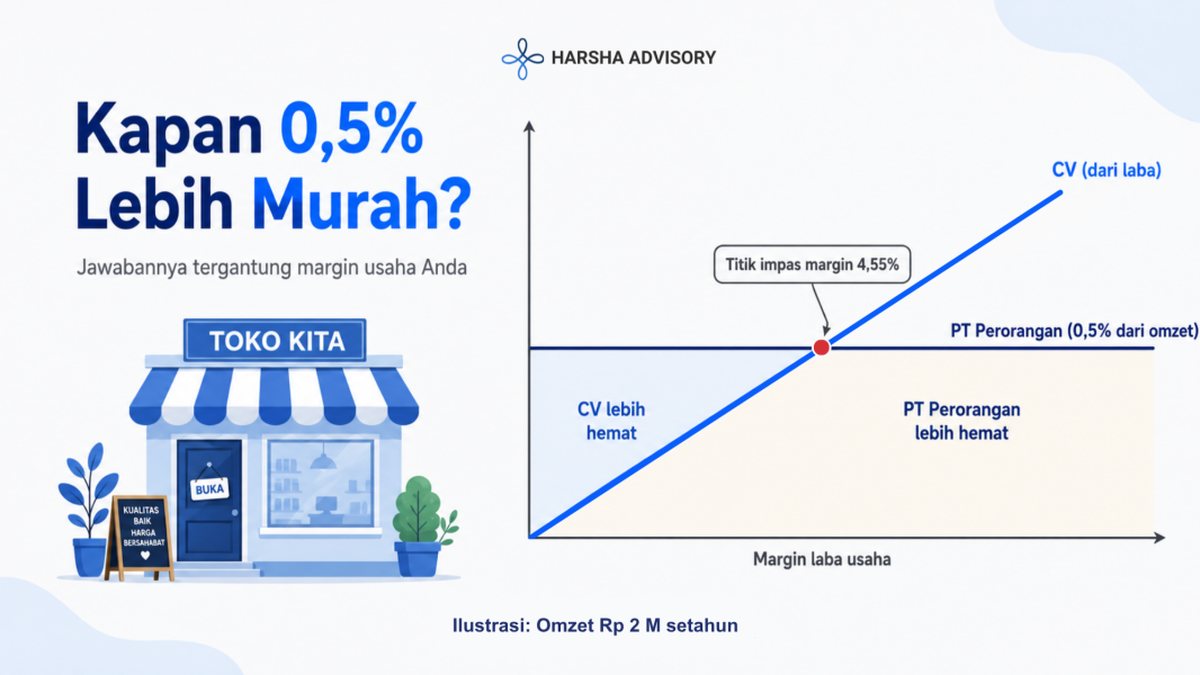
Let's test it with numbers, using an example with revenue of IDR 2 billion. Because this revenue is below IDR 4.8 billion, an entity such as a CV gets an effective rate of 11% on its profit. A PT Perorangan pays 0.5% of revenue, which is IDR 10 million, whatever its margin.
The figures below are illustrative to show the pattern, not a final tax calculation.
At a thin 5% margin (profit of IDR 100 million): the PT Perorangan pays IDR 10 million, the CV pays 11% of IDR 100 million, which is IDR 11 million. Nearly equal, a narrow difference of IDR 1 million.
At a moderate 15% margin (profit of IDR 300 million): the PT Perorangan still pays IDR 10 million, the CV pays 11% of IDR 300 million, which is IDR 33 million. The PT Perorangan saves IDR 23 million.
At a healthy 30% margin (profit of IDR 600 million): the PT Perorangan still pays IDR 10 million, the CV pays IDR 66 million. The PT Perorangan saves IDR 56 million.
The pattern is clear: the higher the margin, the more attractive the 0.5% rate on revenue becomes. But there is a point where the situation reverses.
The break-even point is at a profit margin of around 4.55%. This is a key figure worth remembering. Above a 4.55% margin, the 0.5% rate on revenue is cheaper. Below it, the standard 11% rate on profit is actually lighter.
For example, a business with a very thin 4% margin (profit of IDR 80 million on revenue of IDR 2 billion): the PT Perorangan still pays IDR 10 million, while the standard rate is only 11% of IDR 80 million, which is IDR 8.8 million. Here, the entity on the standard rate actually saves money. And if the business is making a loss, the difference becomes even sharper: the PT Perorangan still pays IDR 10 million, while the entity on the standard rate pays nothing and can carry its loss forward.
This is the biggest misconception about the 0.5% rate: many people assume it is always cheaper. In fact, for businesses with thin margins or those that are struggling, paying tax on revenue can be heavier than paying tax on profit.
Tax is only one side: considerations that often matter more
If the decision were only about tax, this article could stop here. But choosing a business entity touches on things that are often more decisive than the annual tax difference.
A PT Perorangan provides asset protection. As a legal entity, it has a clear separation between the owner's personal assets and the company's assets. If the business runs into debt, the owner's personal assets are in principle protected. But there are limits: a PT Perorangan is only for businesses that meet the micro and small business criteria, with business capital of up to around IDR 5 billion excluding land and buildings. It is also only for a single owner. Another advantage: it is very easy and cheap to set up, entirely through an online system without a notarial deed, with very low official fees.
A CV is more flexible for partnerships and growth. A CV can have more than one partner, which suits a business run together with partners or one that needs a profit-sharing structure. It is also not subject to a capital ceiling like a PT Perorangan, so it is better suited to a business designed to grow large. But there is a serious consequence: active partners bear unlimited liability. There is no separation of assets, so the personal assets of active partners can be exposed if the business makes losses or incurs debts. Setting one up is also more complicated and more expensive, as it requires a notarial deed.
In other words, the PT Perorangan wins on simplicity, low cost, the 0.5% rate and asset protection, but it is locked into small scale and a single owner. The CV wins on partnership flexibility and room to grow, but it requires the standard rate and puts the personal assets of active partners at risk.
Be careful with workarounds: new rules that close the loopholes
After reading that a PT Perorangan can enjoy the 0.5% rate with no time limit, some people may be tempted to work around the rules, for example by splitting a business into several PT Perorangan so that each stays below IDR 4.8 billion. PP 20/2026 has already closed this loophole.
The new rules require the revenue of a husband and wife, together with every PT Perorangan they have founded, to be combined when calculating the IDR 4.8 billion ceiling. If the combined total exceeds the ceiling, all the entities lose their right to the 0.5% rate. So splitting the business is no longer effective, and it risks forfeiting the facility for every entity at once.
There are also important exclusions: income from independent professional work, such as experts (doctors, lawyers, accountants, architects, consultants, notaries) and digital creative workers (content creators, influencers, Instagram celebrities), cannot use the 0.5% rate. A PT Perorangan founded by an expert to deliver services of the same kind as their independent professional work is also excluded. This is important to check before you decide.
How to choose: a practical framework
A few principles to help with your decision.
Start from the direction of the business, not the tax rate. The first question is not "which one has the lowest tax", but "what will this business look like in three to five years". How many owners it has, how large it will grow, how much risk it carries, how important asset protection is.
If you run the business on your own, it is micro to small in scale, and your margin is healthy, a PT Perorangan is often a strong choice: the 0.5% rate with no time limit, asset protection and cheap setup. Make sure your margin is above the 4.55% break-even point so that the 0.5% rate genuinely works in your favour.
If there is more than one owner, you need a structure for partners, or the business is designed to grow beyond small scale, a CV still makes sense even without the 0.5% facility. Losing it is a cost, but one that is often worth the flexibility and room to grow that a CV provides.
If you own a CV that currently uses the 0.5% rate, check how much of your transition period remains, calculate your real margin, and prepare complete bookkeeping. If your margin is thin, moving to the standard rate may actually save tax rather than add to the burden.
For the final decision, involve a tax consultant. The actual calculation involves fiscal adjustments, deductible expenses and specific details of your business that cannot be generalised from any article.
Closing
The lesson from PP 20/2026 is not "the PT Perorangan wins" or "the CV loses". The lesson runs deeper: choosing a business entity is not about today's tax rate, but about where your business is heading, the number of owners, the level of risk, growth plans and asset protection.
Tax rates can change, as has just happened. What does not change is the importance of choosing the right vehicle from the start, in line with where you intend to take your business. Choose the right structure first, and let the tax considerations fit within it, not the other way round.
A healthy business is not just one that makes a profit, but one that understands its numbers, controls its risks, and moves with a clear direction.
References
- PP 20/2026: users of the 0.5% PPh Final narrowed to individual taxpayers, PT Perorangan and cooperatives; CVs, firms, ordinary PTs and BUMDes can no longer become new users; the time limit removed for individuals and PT Perorangan. Peraturan Pemerintah Nomor 20 Tahun 2026 (Government Regulation No. 20 of 2026), effective 22 April 2026. Official statements from the Direktorat Jenderal Pajak (Directorate General of Taxes, pajak.go.id) and the Kementerian Keuangan (Ministry of Finance).
- Transition period for CVs, firms and PTs registered before 22 April 2026 (PTs up to 3 years, CVs and firms up to 4 years from registration; cooperatives until Tax Year 2029). Article II of PP 20/2026, as reported by DDTCNews, CNBC Indonesia and Ortax.
- The standard 22% PPh Badan rate and the Article 31E UU PPh facility (50% reduction, an effective rate of 11% for revenue of up to IDR 4.8 billion). Undang-Undang PPh (Income Tax Law) and statements from the Direktorat Jenderal Pajak.
- Rules on combining the revenue of husbands, wives and sole-proprietor companies, and the exclusions for independent professional work and digital creative workers. PP 20/2026, as analysed by DDTCNews and Ortax.
- Criteria for and establishment of a PT Perorangan (micro and small businesses, maximum capital of IDR 5 billion excluding land and buildings, online setup without a notary) and the characteristics of a CV (unlimited liability of active partners, requires a notarial deed). UU Cipta Kerja (Job Creation Law) and its implementing regulations, and Klinik Hukumonline.
The 4.55% break-even point assumes revenue does not exceed IDR 4.8 billion, so that all taxable profit receives the 11% effective rate. For revenue between IDR 4.8 billion and IDR 50 billion, the effective rate becomes a blend and the break-even point shifts. The example calculations are illustrative and assume commercial profit equals taxable profit with no fiscal adjustments. For a final decision, refer to the official text of the regulations and consult a tax consultant.