Introduction
Ever since talk of a 12% PPN (value-added tax) rate began, one sentence has been heard again and again among business owners: "PPN is going up to 12%, so my margin will automatically shrink." The worry is understandable. But before joining in, there is one thing that needs to be set straight, because this misconception is widespread and can lead to business decisions being made on the wrong basis.
In reality, for most businesses selling ordinary goods and services, the effective PPN rate has not changed. What can genuinely shift your margin is not the rate increase itself, but how you treat PPN in your pricing: whether your price already includes PPN (inclusive) or not (exclusive). And this shift can happen at any rate, even with no increase at all.
This article sets out what has and has not actually changed in the latest PPN policy, then breaks down the inclusive versus exclusive mechanism, which is what most often leaves business owners unaware that their margin has shifted. In our experience supporting many kinds of companies, confusion about PPN in pricing causes losses far more often than the rate increase itself.
Note: this article is educational and is not a substitute for advice from a tax consultant. Tax rules can change; please verify against the latest regulations and with your tax consultant.
What has really changed, and what hasn't
Let's first get the facts straight, because they are the foundation for every decision that follows.
Under the provisions of PMK 131/2024 (Minister of Finance Regulation No. 131 of 2024), in force since 1 January 2025, the 12% PPN rate applies only to goods and services classified as luxury. This category covers goods that have already been subject to PPnBM (sales tax on luxury goods), such as certain motor vehicles, very luxurious homes, private aircraft, yachts and the like.
For ordinary goods and services that are not classified as luxury, which covers most products such as food, beverages, retail products and services in general, the effective PPN rate remains 11%. Technically, this is achieved through an alternative tax base (DPP nilai lain) mechanism, in which the 12% rate is multiplied by 11/12 of the selling price, so that the final result is equivalent to 11%. The Ministry of Finance has also confirmed that there will be no change to this rate policy for 2026.
This means that for most business owners selling non-luxury goods and services, the big news is actually this: your effective rate has not changed. The worry that "12% PPN is eating into my margin" is largely based on an incomplete understanding of how the policy is actually applied.
However, this does not mean PPN is irrelevant to your margin. This is precisely where the real problem is often missed.
The real problem: inclusive vs exclusive
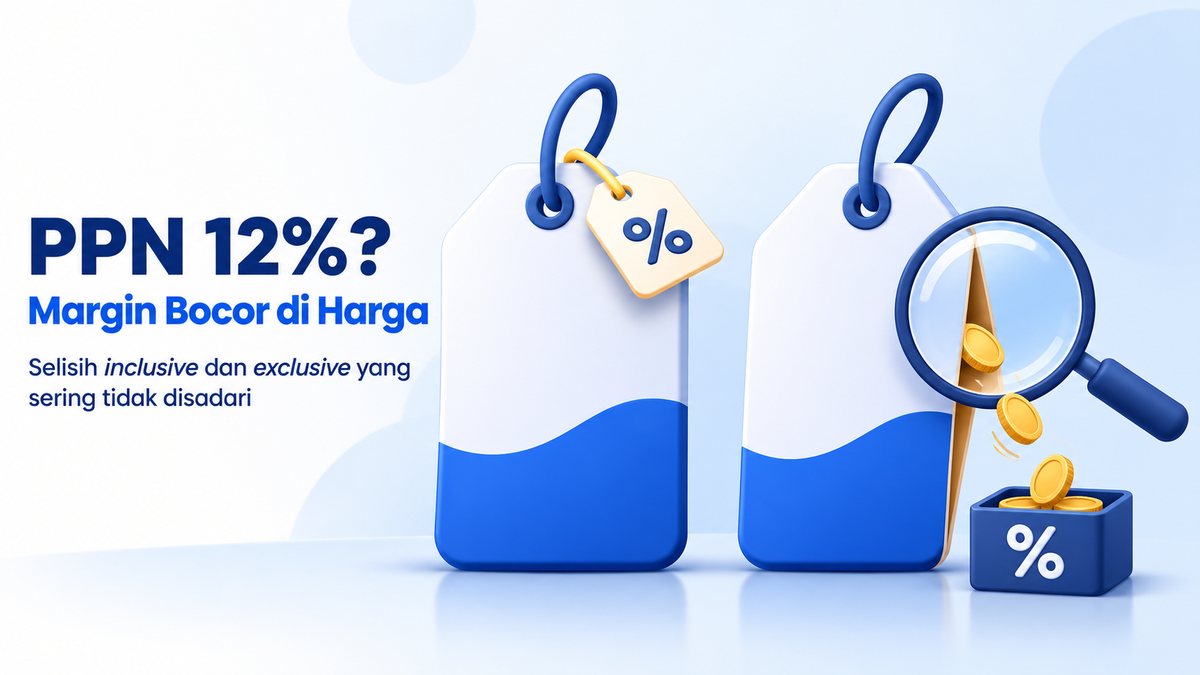
What genuinely shifts many business owners' margins is not the rate, but confusion over whether the prices they set already include PPN or not. These are two different approaches, and mixing them up is a real source of margin leakage.
Exclusive pricing (PPN not yet included). The price you set is the base price, and PPN is added on top when you invoice. If you sell a service for IDR 1,000,000 exclusive, the customer pays IDR 1,110,000, and that IDR 110,000 is PPN that you pass on to the state. Your margin is calculated on the full IDR 1,000,000.
Inclusive pricing (PPN already included). The price you display is the final price the customer pays, and PPN is already contained within it. If you sell for IDR 1,000,000 inclusive, part of that amount is actually PPN you must remit, and your true base price is lower than IDR 1,000,000.
This is where the margin shift happens. Many business owners set prices as if they were their base price (calculating margin on the full amount), when for tax purposes the price is treated as inclusive. As a result, part of what they think is margin is actually PPN that must be remitted. Their real margin is thinner than what is recorded, and this gap is exactly the kind of leak that stays invisible until it is calculated correctly.
Why this shift often goes unnoticed
There are several reasons why the inclusive versus exclusive issue so often escapes business owners' attention.
The displayed price feels like it fully "belongs" to the business. When you set a price of IDR 50,000 for a product, you instinctively calculate your margin on that IDR 50,000. Yet if the price is inclusive of PPN, a small part of it is not yours, but tax held in trust that must be passed on. This instinct is what makes the margin feel larger than it really is.
Mixing consumer prices with business-to-business prices. Sales to end consumers are usually displayed inclusive, while business-to-business sales are often exclusive. A business that serves both can unknowingly mix these two logics, producing inconsistent margins across segments.
Confusing PKP and non-PKP status. Whether and how a business must collect PPN depends on its status as a PKP (Pengusaha Kena Pajak, a VAT-registered business). Uncertainty about this status often leaves business owners unsure whether they should be adding PPN, have already included it, or should not be charging it at all.
Pricing that is set once and then left alone. As with many pricing decisions, the PPN treatment is often decided at the start and never reviewed, so an early error in treatment keeps being carried forward undetected.
Case illustration: two businesses, different PPN treatment
This case is illustrative and does not represent any particular client engagement. The figures are simplified to illustrate the principle.
Imagine two service businesses that both set a service price of IDR 1,000,000 and are both PKP required to collect PPN. Their cost structures are identical, with direct costs of IDR 600,000 per service. At first glance, their margins look the same. But their PPN treatment differs, and that changes everything.
The first business treats its price as exclusive. Its base price is IDR 1,000,000, and 11% PPN is added on top. The customer pays IDR 1,110,000, of which IDR 110,000 is passed on to the state as PPN. The business's margin is calculated as IDR 1,000,000 minus costs of IDR 600,000, giving IDR 400,000 per service. The calculation is clean and as expected.
The second business displays IDR 1,000,000 as the final price without separating out PPN. The customer pays IDR 1,000,000, but because this business is a PKP, part of that amount must still be treated as PPN to be remitted. Under the inclusive approach, about IDR 99,000 of that IDR 1,000,000 is the PPN component, so the real base price is only about IDR 901,000. After deducting costs of IDR 600,000, the actual margin is only about IDR 301,000 per service, not IDR 400,000 as the business thinks.
The difference is about IDR 99,000 per service, or almost 10% of the price. Not because the PPN rate went up, not because costs increased, but purely because of an unrecognised PPN treatment in pricing. All along, the second business thought its margin was 40%, when in reality it was around 30%. That gap is big enough to decide whether a business is healthy or not.
What is interesting: both businesses can be correct from a tax standpoint. The mistake is not the choice of inclusive or exclusive, but that the second business did not realise its price was being treated as inclusive, and so miscalculated its own margin.
How to start straightening out PPN treatment in pricing
A few practical steps to make sure PPN is not quietly eroding your margin:
Confirm your business's PPN status first. Whether or not your business must collect PPN (has PKP status) determines the whole approach that follows. If you are unsure, this is the first question to take to a tax consultant.
Decide deliberately: is your price inclusive or exclusive? Do not leave this ambiguous. Decide on purpose, and make sure everyone on the team who sets prices understands that decision and applies it consistently.
Calculate margin on the base price, not on a price that contains PPN. If your price is inclusive, strip out the PPN component before calculating margin. A margin calculated on a figure that still contains PPN will always look larger than it really is.
Keep the treatment consistent across segments and channels. If you serve both end consumers and other businesses, make sure your PPN logic is consistent and that you understand how the treatment differs for each, so your margin does not shift unnoticed between segments.
Review when regulations change. Although the effective rate for non-luxury goods is currently still 11%, tax regulations can change. Make PPN treatment part of your regular price review.
Closing
The most important news on this topic may well be the most reassuring: for most businesses selling ordinary goods and services, 12% PPN does not change your effective rate, which remains 11%. The worry that the rate increase will eat into margins largely stems from a misconception about how the policy is applied.
But there is a deeper and more lasting lesson behind it. What genuinely shifts margins is often not the rate change that makes the headlines, but mechanisms that are unseen and not understood, such as the difference between inclusive and exclusive in pricing. The most dangerous margin leaks are the invisible ones, because nobody is looking for them.
Understanding how PPN is treated in your prices, and calculating margin from the right figure, is one of the simplest yet most often overlooked fixes in managing a business's financial health. It does not require deep tax expertise, only the awareness to check what has so far been assumed.
A healthy business is not just one that makes a profit, but one that understands its numbers, controls its risks, and moves with a clear direction.
References
- The 12% PPN rate applies only to luxury goods/services; non-luxury items remain at an effective 11% through the DPP nilai lain (alternative tax base) mechanism (12% x 11/12 of the selling price). Peraturan Menteri Keuangan (PMK) Nomor 131 Tahun 2024 (Minister of Finance Regulation No. 131 of 2024), in force since 1 January 2025.
- Confirmation that there will be no change to the PPN rate policy for 2026. Statement by the Director General of Economic and Fiscal Strategy at the Ministry of Finance, as reported by DDTCNews and Kompas (August 2025).
- Categories of luxury goods subject to 12% PPN (vehicles subject to PPnBM, very luxurious homes, private aircraft, yachts and the like). Official government statements and PMK 131/2024.
PPN status and rates, as well as PKP rules, can change and apply in specific ways to each type of business. The example calculations are illustrative. Please verify against the latest regulations and with a tax consultant before making decisions.