
Introduction
As year-end closing approaches, many PT (limited liability company) owners face the same question: this year's profit is already in sight, so what is the best way to take it home? Through a salary as a director, or through dividends after the RUPS (general meeting of shareholders)?
This question is often answered out of habit rather than by calculation. Yet in our simulation, the choice of how to take profit changed the amount the owner received by almost IDR 18 million on a profit of IDR 100 million, and by around IDR 73 million on a profit of IDR 3 billion.
More interestingly, the most tax-efficient answer for a small profit does not hold for a large one. The pattern changes once the owner's salary moves into a higher tax bracket.
This article explains how each route is taxed, compares them using two case studies with concrete figures, and then covers the variables that are often overlooked: reinvested dividends and family ownership structures. From our experience helping companies put their finances in order, decisions like this are best made before year-end closing, not after the tax return has been prepared.
Note: this article is educational and summarizes general tax provisions from official sources and tax media. The figures in the case studies are simulations based on simplified assumptions. This article is not a substitute for advice from a tax consultant. For application to your company's specific circumstances, please consult a tax consultant or financial advisor.
Two ways money leaves a PT
In a PT, the company's money is not the owner's personal money. Moving it into a personal account must go through a legitimate route, and each route is treated differently for tax purposes.
First, salary. An owner who serves as director receives a salary for their work. For the PT, salary is an expense that reduces taxable profit. For the owner, salary is subject to PPh Pasal 21 (employee income tax) at progressive rates: 5% on taxable income up to IDR 60 million, 15% up to IDR 250 million, 25% up to IDR 500 million, 30% up to IDR 5 billion, and 35% above that. Before the rates are applied, the salary is first reduced by the occupational expense allowance (biaya jabatan) and the non-taxable income threshold (Penghasilan Tidak Kena Pajak, or PTKP).
Second, dividends. Profit after tax is distributed to shareholders based on a RUPS resolution. That profit has already been subject to corporate income tax (PPh Badan) at the PT level, and is then subject to a 10% final income tax (PPh Final) when received by an individual shareholder, unless it is reinvested in accordance with the rules. In other words, the dividend route is taxed twice.
A third route, often used without realizing it, is charging the owner's personal spending as a company expense. According to the elucidation of Article 4(1)(g) of the UU PPh (Income Tax Law), company spending for the personal needs of shareholders that is charged as an expense falls within the definition of a dividend. So instead of saving tax, the expense is disallowed at the PT level and is still treated as a dividend to the owner.
Case 1: profit of IDR 100 million
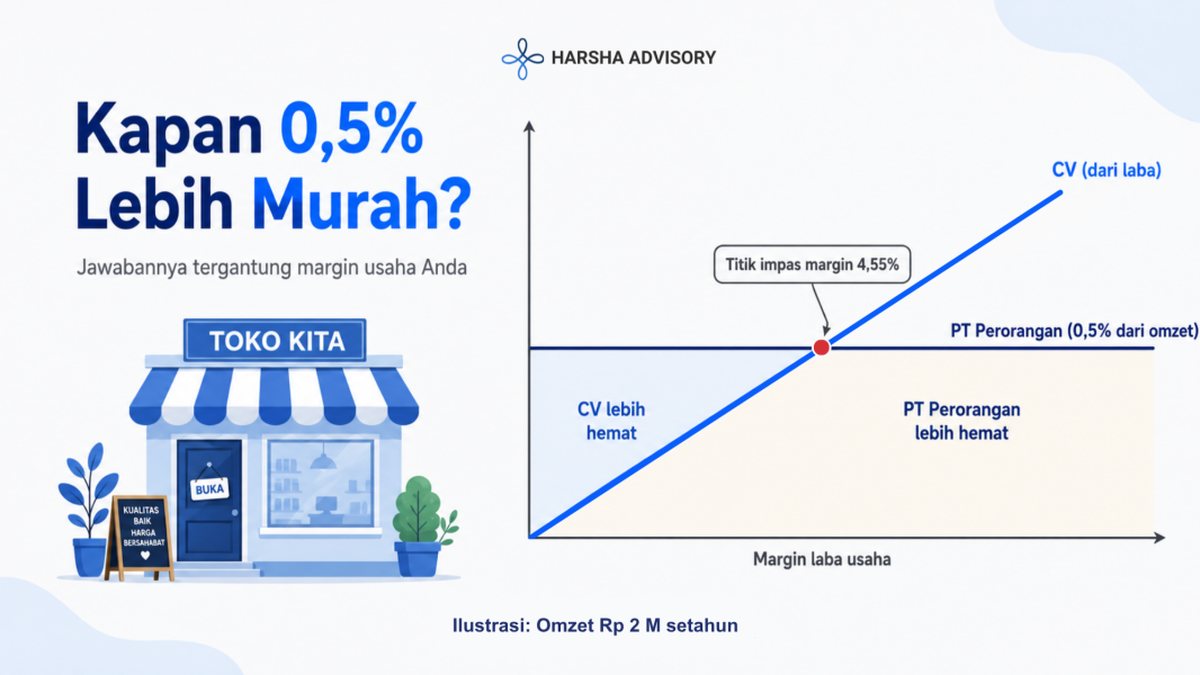
Mr. Hendra is the owner and director of a PT with annual revenue of IDR 3 billion. Profit before the owner's salary is IDR 100 million, and he is single. Since PP 20/2026 (Government Regulation 20 of 2026) took effect, PTs can no longer use the 0.5% PPh Final regime, except those still within the transition period. Mr. Hendra's PT uses the standard rate with the Article 31E facility, so its effective corporate income tax rate is 11%.
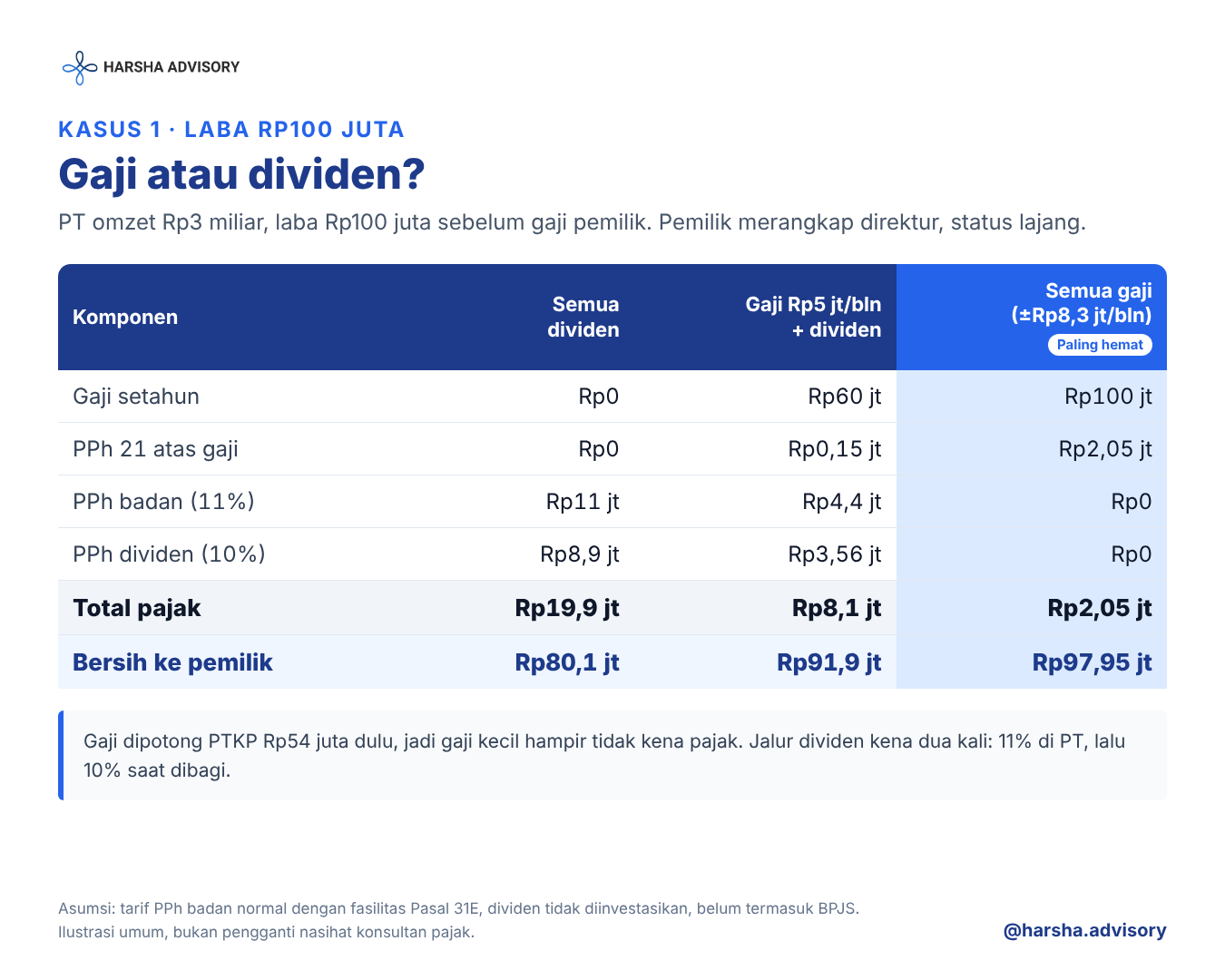
The difference is substantial. If all profit is taken as dividends, Mr. Hendra takes home IDR 80.1 million, with total tax of IDR 19.9 million. If all of it is taken as salary (around IDR 8.3 million per month), he takes home IDR 97.95 million, with total tax of only IDR 2.05 million.
The key is the non-taxable income threshold. The first IDR 54 million of annual salary is not taxed at all, and the 5% occupational expense allowance is deducted first as well. Of an IDR 100 million salary, only IDR 41 million is actually taxed, at 5%, so the PPh 21 is IDR 2.05 million.
The dividend route, by contrast, carries a burden of almost 20%. Every IDR 1 of profit is taxed at 11% at the PT level, and then 10% of the remainder when it is distributed.
Case 2: profit of IDR 3 billion
Now imagine Mr. Hendra's business has grown. Revenue is IDR 60 billion and profit is IDR 3 billion. Because revenue exceeds IDR 50 billion, the Article 31E facility no longer applies, and corporate income tax is charged at the full 22% rate.
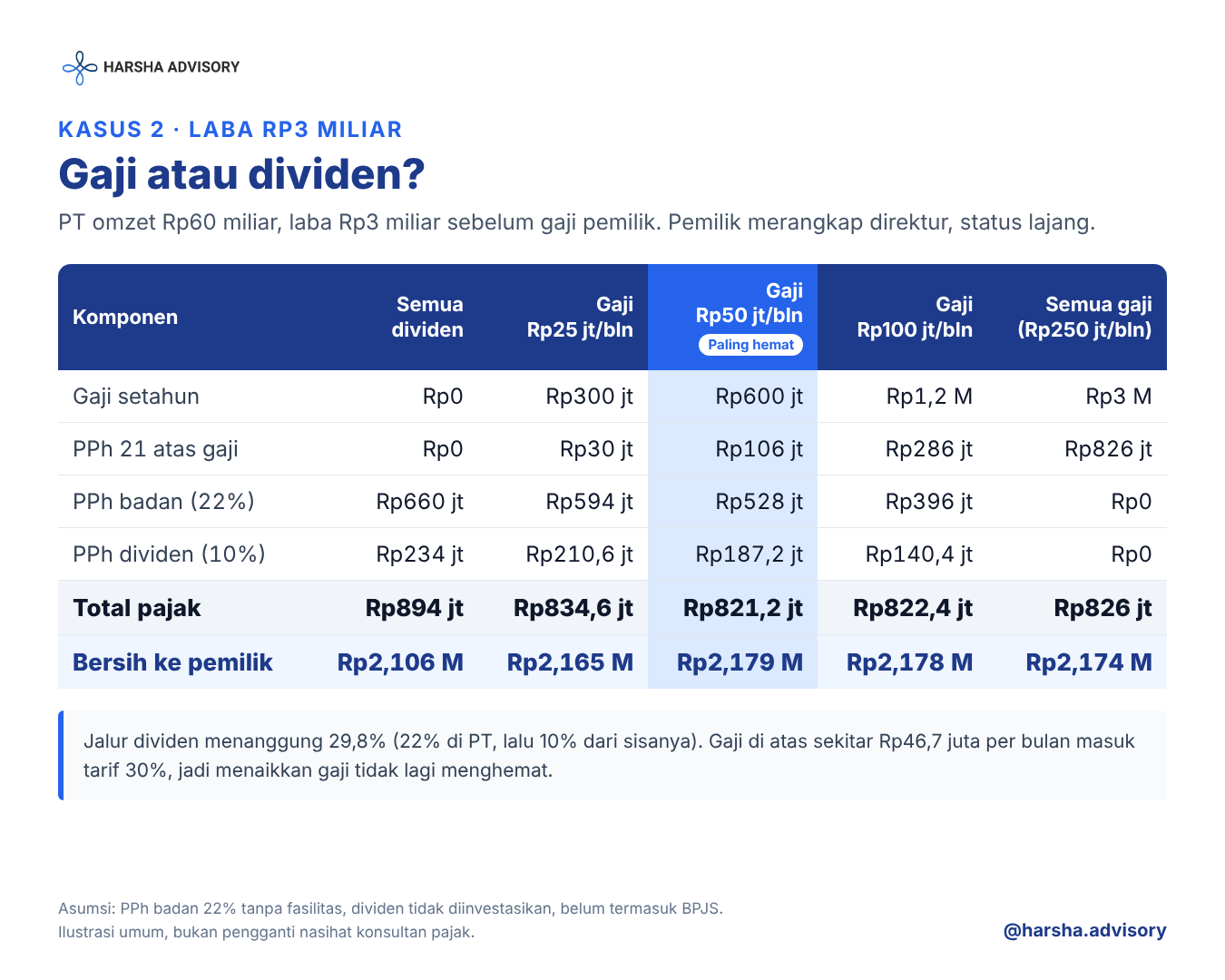
The pattern changes. Moving from all dividends to a salary of IDR 25 million per month lowers total tax by IDR 59 million. Raising the salary to IDR 50 million per month lowers tax by another IDR 13 million. Beyond that, raising the salary saves nothing. A salary of IDR 100 million per month is slightly more expensive, and taking all profit as salary (IDR 250 million per month) is not the most tax-efficient option either.
The explanation lies in the tax brackets. The dividend route carries a burden of 29.8%: 22% at the PT level plus 10% of the remainder. The salary route is only cheaper as long as its bracket rate stays below that figure. Once taxable income from salary exceeds IDR 500 million a year, the rate rises to 30%, and every additional rupiah of salary is already more expensive than the dividend route.
In this case, the threshold is a salary of around IDR 560 million a year, or IDR 46.7 million per month. At that point, the owner's taxable income is exactly IDR 500 million.
An often overlooked variable: reinvested dividends
Domestic dividends received by individuals can be exempt from income tax, provided they are invested in Indonesia in accordance with the rules. The dividends are still distributed to and received by the owner. What makes the difference is what is done with the money afterwards.
All the conditions must be met. The dividends must be placed in instruments set out in PMK 18/2021 (Minister of Finance Regulation 18 of 2021), including government securities, listed shares, bonds, property, or direct investment in companies in Indonesia. The placement must be made no later than the end of the third month after the tax year ends, so dividends received in 2026 must be invested before the end of March 2027. The investment must be held for at least three tax years, and its realization must be reported to the DJP (Directorate General of Taxes).
If the conditions are met, the burden on the dividend route drops to just 22%. As a result, salary that has already entered the 25% bracket becomes more expensive than dividends. In Case 2, total tax with a salary of IDR 25 million per month becomes IDR 624 million, lower than with a salary of IDR 50 million per month, which reaches IDR 634 million. The optimal salary threshold falls to around IDR 310 million a year.
The implication is that the salary decision cannot be separated from how the money will be used. Money for living expenses makes more sense taken as salary. Money that will genuinely be reinvested can be more efficient taken as dividends.
What about family-owned PTs?
The examples above simplify ownership to a single person. In practice, a standard PT (PT persekutuan modal, a capital-based company) must be established by at least two people. Many PTs are jointly owned with a spouse or siblings, and this affects the calculation.
How shares are divided does not change the total dividend tax. Because dividend tax for individuals is a final 10%, the total dividend tax stays the same regardless of who receives it.
A married couple without a prenuptial or postnuptial separation of property agreement is treated as one party. Both spouses' shares are joint marital property, so they cannot be the only two shareholders of a standard PT. The options are to make a separation of property agreement or to add another shareholder.
Paying a salary to family members who genuinely work in the business can lower total tax. A spouse or sibling who is an employee gets their own non-taxable income threshold, and their tax brackets are calculated separately starting from 5%. In Case 2, if the husband and wife are each paid IDR 50 million per month, total tax falls from around IDR 820 million to IDR 747 million.
But this is where the greatest risk lies. Spouses and siblings are related parties. Compensation to shareholders or related parties that exceeds what is reasonable cannot be deducted as a PT expense, and may be treated as a dividend. If a family member is only listed as a director without actually doing the work, this saving is at risk of being corrected by the tax authority.
For siblings, there is one more point to note. Salary and dividends received by a sibling are legally that sibling's income. The only gifts exempt from tax are those between blood relatives in a direct line of one degree, namely parents and children. If the money is handed back to the main owner, that transfer may become taxable income for the recipient.
What to consider beyond tax
The calculations in this article are deliberately simplified. In practice, several other factors also shape the final decision.
Reasonableness of salary. The owner's salary must match the work they actually perform as director, and be comparable to compensation for similar positions.
Retained earnings. Taking out all profit, whether through salary or dividends, leaves the PT with no reserves for working capital and expansion.
BPJS contributions. A higher salary also changes the social security (BPJS) contributions borne by the company and the employee. The simulation in this article does not include them yet.
Status and facilities. The non-taxable income threshold differs for single and married status and for the number of dependants. PTs with revenue of up to IDR 50 billion also receive the Article 31E facility on part of their profit, which shifts the optimal point.
Closing
There is no single answer to the question "salary or dividends". The most tax-efficient point for each business is determined by three things: the size of the PT's profit, the owner's salary tax bracket, and whether the dividends will be spent or reinvested. A family ownership structure adds one more layer of consideration.
What is clear is that this decision should be made by calculation, not habit. The best time to run the numbers is before year-end closing, while the options are still open, not after the tax return has been prepared.
A healthy business is not just one that makes a profit, but one that understands its numbers, controls its risks, and moves in a clear direction.
References
- Individual income tax brackets (5%, 15%, 25%, 30%, 35%) under Article 17 of the UU PPh as amended by the UU HPP (Harmonization of Tax Regulations Law). Directorate General of Taxes, pajak.go.id/en/node/90251.
- 10% final income tax on dividends received by individuals, the exemption when invested for at least three tax years, the placement deadline at the end of the third month after the tax year, and the obligation to report realization (PMK 18/2021, PMK 81/2024 Articles 370 to 374). DDTCNews, news.ddtc.co.id/berita/nasional/1817052 and news.ddtc.co.id/berita/nasional/45282.
- The definition of dividends includes spending for the personal needs of shareholders that is charged as an expense (Elucidation of Article 4(1)(g) of the UU PPh). DDTCNews, news.ddtc.co.id/literasi/kamus/19187.
- PP 20/2026 effective 22 April 2026; the 0.5% final income tax rate applies only to individuals, sole-proprietor companies (perseroan perorangan), and cooperatives, with a transition period for entities already using it. DDTCNews, news.ddtc.co.id/berita/daerah/1819954.
- The Article 31E UU PPh facility, a 50% rate reduction on taxable income from the portion of gross revenue up to IDR 4.8 billion, for corporate taxpayers with gross revenue of up to IDR 50 billion; corporate income tax rate of 22%. DDTCNews, news.ddtc.co.id/berita/nasional/1810053, and IKPI, ikpi.or.id/en/?p=31388.
- A married couple without a separation of property agreement is treated as a single interest when establishing a standard PT (PT persekutuan modal). Hukumonline, hukumonline.com/klinik/a/ini-3-ketentuan-agar-suami-istri-bisa-dirikan-pt-cl1057.
- Spouses working at the same company each have PPh 21 withheld, and a wife's income from a single employer is treated as final in the husband's tax return if their NPWP (taxpayer identification numbers) are combined. DDTCNews, news.ddtc.co.id/berita/nasional/1801806 and news.ddtc.co.id/berita/nasional/1817763.
- Spouses and blood or in-law relatives in the collateral line of one degree are related parties; compensation to shareholders or related parties that exceeds what is reasonable cannot be deducted (Article 9(1)(f) and Article 18(4) of the UU PPh). DDTCNews, news.ddtc.co.id/berita/nasional/1812867.
- Non-taxable income threshold (IDR 54 million for single taxpayers, plus IDR 4.5 million for married status and for each dependant) under PMK 101/2016. DDTCNews, news.ddtc.co.id/berita/nasional/1822905.
This article summarizes general tax provisions for educational purposes and is not a substitute for advice from a tax consultant. The figures in the case studies are simulations based on simplified assumptions and do not yet include BPJS contributions. For decisions on your company's specific circumstances, please consult a tax consultant or financial advisor.