Introduction
Pilates studios are popping up everywhere, especially in Jakarta and Bali. Classes are full, members are enthusiastic, and the price per session feels premium. From the outside, it looks like a highly profitable wellness business.
But there is a gap between a busy studio and a profitable one. And as with the café and spa businesses we have covered before, that gap lies in a cost structure that visitors never see.
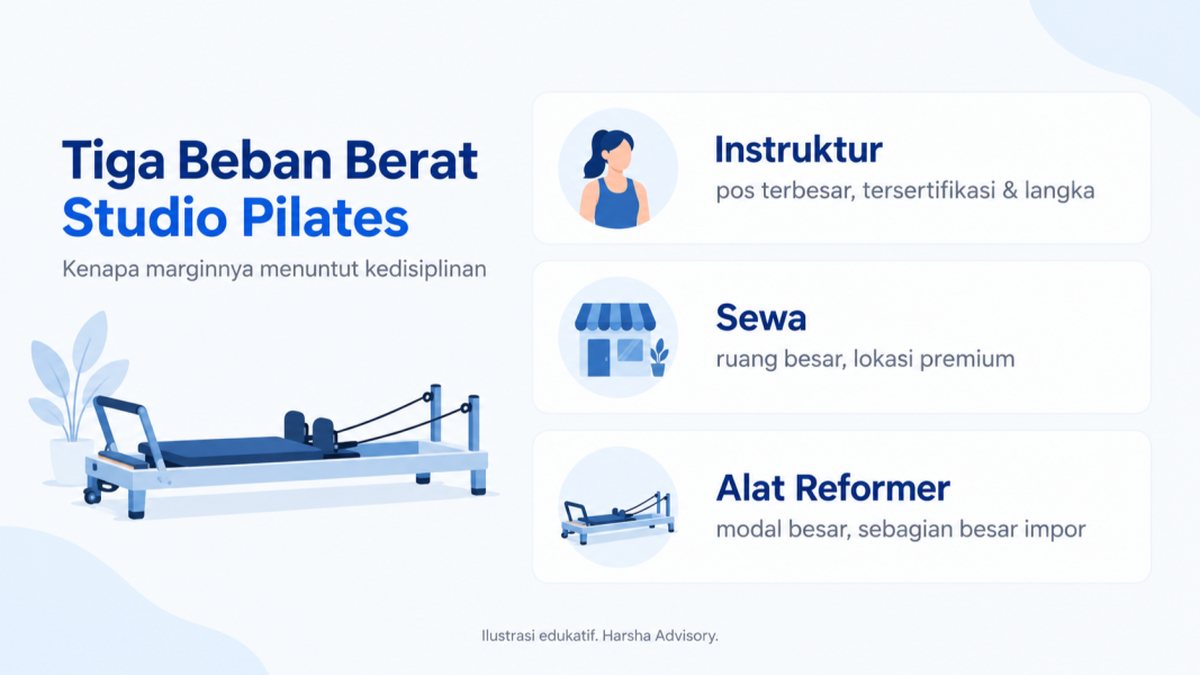
Pilates has a distinctive cost profile. It combines three heavy burdens at once: rent for a large space in a premium location, certified instructors who are expensive and scarce, and reformer machines that are far from cheap and mostly still imported. All three come together in a business model with limited class capacity.
This article breaks down the cost structure of a pilates studio line by line, using data from real operators and franchises, explains what a realistic net margin looks like, and highlights the one metric that most determines whether a studio survives or fails. In our experience supporting many types of companies, trending businesses often attract a wave of new players who have not fully worked out their cost structure.
Note: most of the financial data in this article comes from operators and franchises outside Indonesia and serves as a reference point, not an Indonesian standard. We have not found any comprehensively published financial statements for Indonesian pilates studios. Figures in the case example are illustrative.
What is a realistic net margin
Let us start with the numbers, using the most defensible data available.
For a well-run pilates studio, a number of industry operating benchmarks put net margin in the range of 10% to 25%. To be clear, these figures are indicative rather than a universal standard, as most come from software providers and industry observers, not audited reports. By contrast, several industry estimates citing IBISWorld data put the average margin for the pilates and yoga sector in the United States much thinner, at around 6.7% in 2024, because instructor costs absorb a large share of revenue.
The world's largest franchise offers a more concrete picture of revenue. Club Pilates, the largest pilates chain globally under Xponential Fitness, disclosed in its Franchise Disclosure Document 2025 that average annual revenue per studio (across 849 studios) was around USD 984,270, with a median of USD 969,022. The range is wide, from a minimum of around USD 356,528 to a maximum of more than USD 2.3 million.
It is important to note that the document discloses revenue but not net profit per studio. This means the revenue figure cannot be translated directly into a net margin without assuming a cost structure. All we can conclude is that a mature studio generates substantial revenue, but how much remains as profit still depends on each studio's cost discipline.
One point needs clarifying: the listed parent company, Xponential Fitness, actually reports a loss at the corporate level. But that is the margin of the franchisor (whose revenue comes from royalties and equipment sales), not the margin of an operating studio. The two should not be confused.
The takeaway from all this: the net margin of a well-run pilates studio is indicatively in the low teens to low twenties in percentage terms, but the industry average is much thinner, and the figure is highly sensitive to one factor we will discuss below. This is not a business with the spectacular margins people sometimes imagine, and the exact figure can only be known once a studio's cost structure has actually been worked out.
Breaking down the cost structure
Where does a pilates studio's revenue go? Let us break down the three largest cost lines plus the supporting costs.
Instructors: the largest cost line and the largest risk. This is a defining feature of the pilates business. Pilates instructors must be certified, and comprehensive certification from an international body takes hundreds of hours of training and costs thousands of dollars. As a result, quality instructors are scarce and have strong bargaining power. Instructor costs should ideally sit in the range of 35% to 45% of revenue. Once they go above 45%, studio margins come under pressure quickly. There is also a structural risk: if instructors are paid per class on a fixed schedule, this cost does not fall when classes are not full.
Rent: heavy, especially in premium locations. A pilates studio needs a large space with a sturdy floor and high ceilings, usually in a strategic location that appeals to its target market. Industry benchmarks suggest keeping rent below 15% to 20% of revenue. In areas such as South Jakarta, rent for commercial space suitable for a studio can reach hundreds of millions to more than one billion rupiah per year, making it an inflexible fixed cost.
Reformer equipment: large upfront capital. This is what sets pilates apart from most other fitness businesses. A reformer studio needs around 8 to 12 machines, and quality reformers are not cheap. Imported machines from well-known brands are the most expensive, and local industry players confirm that quality equipment is still mostly imported, which makes it highly sensitive to rupiah exchange rate fluctuations. The equipment also has to be depreciated and maintained, adding recurring costs on top of the initial capital.
Supporting costs. Beyond those three major lines, there are utilities (air conditioning for a large space is not cheap), marketing to attract new members, booking software and transaction fees, insurance, and reception staff. Each looks small on its own, but they add up.
When all these lines are added together, it becomes clear why pilates studio margins are moderate rather than spectacular. And what makes it all risky is one factor that decides whether these fixed costs are covered or not.
The metric that decides survival: class occupancy
If there is one number that most determines whether a pilates studio is healthy, it is the class occupancy rate.
Reformer classes have limited capacity, usually 6 to 12 people. Meanwhile, the studio's largest costs, instructors and rent, are fixed. Instructors are still paid to teach the class, and rent keeps running, whether the class is full or only half full.
This means every empty seat in a class is a fixed cost running without generating revenue. It is exactly like the empty bed phenomenon in the spa business. A studio can look busy with a packed class schedule, but if average occupancy per class is low, its margin quietly leaks away.
Conversely, raising class occupancy has a large impact on margin, because the additional revenue goes almost entirely toward covering costs that already exist. This is why healthy operators keep occupancy high and steer members toward subscription memberships rather than single-use class packages, to maintain a stable, recurring revenue stream.
Case illustration: the power of occupancy
This case example is illustrative and does not represent any specific client engagement. Figures are simplified.
Imagine a studio with 8 reformers in South Jakarta, running 6 classes a day. Its total capacity is around 1,248 class seats per month. The average price is IDR 180,000 per seat. Let us look at two scenarios.
Healthy occupancy scenario (65%). Class revenue is around IDR 146 million, plus private sessions and other income, for a total of around IDR 180 million per month. The largest costs: instructors 38%, rent 15%, plus equipment depreciation, utilities, marketing, staff and other costs. Total costs come to around 85%, leaving a net margin of 15%, or around IDR 27 million. Healthy, and in line with the benchmark for a well-run studio.
Low occupancy scenario (40%). Now, with exactly the same class schedule and fixed costs, occupancy falls to 40%. Class revenue drops to around IDR 90 million, for a total of around IDR 118 million. But instructor costs stay at IDR 68 million, because the classes still run, and that now equals 58% of revenue. Rent stays the same. As a result, a studio that was making a 15% profit is now making a loss.
Notice what happened. A fall in occupancy from 65% to 40%, with no change at all to the cost structure, turned the studio from profit to loss. This shows how fragile pilates margins are to one variable: class occupancy. Empty reformer seats, just like empty beds in a spa, destroy margin because instructors and rent keep running.
The Indonesian context: opportunity and caution
Pilates in Indonesia has strong momentum. One business database (POI Data) identified around 545 pilates studio listings in Indonesia in a snapshot as of 2025, with the largest concentrations in Jakarta and Bali. This figure is based on listings, not an official census, but the direction of the trend is clear: interest is growing fast, especially among young urban consumers.
But this momentum also calls for caution, and several lessons from the discussion above apply directly.
First, the initial capital is front-loaded. The combination of space renovation, purchasing reformer equipment (which is exchange-rate sensitive because much of it is imported), and other startup costs means a significant investment. The payback also tends to be slow. As one reference point from the Indonesian market, the President Director of KX Pilates Indonesia said in a media interview that break-even was reached in the third year. This is one operator's experience, not a universal benchmark, but it shows that payback in this business is measured in years, not months.
Second, competition is intensifying quickly. When many studios open in the same area and compete for the same pool of members, pressure on pricing and occupancy increases. Studios that do not protect their occupancy will be the first to feel the margin squeeze.
Third, reliance on star instructors is a real risk. In a personal business like this, when a popular instructor moves on, some members often follow. This makes it all the more important to build a strong studio brand rather than relying only on individual personalities.
The implication is that a pilates studio in Indonesia that wants to be financially healthy cannot rely on the trend alone. It needs to protect class occupancy, manage instructor and rent costs with discipline, and build a recurring member base that is loyal to the studio.
How to read these numbers for your studio
A few practical principles.
Lock in rent from the start. Aim to keep rent below 15% to 20% of projected revenue. If a premium location forces rent well above that, the business model deserves a second look before you commit.
Keep instructor costs in the range of 35% to 45% of revenue. If they are heading above 45%, that is a signal that prices are too low or there are too many classes on the schedule for current demand.
Make class occupancy your key metric. Track average occupancy per class, not just the number of classes running. Persistently low occupancy is a signal to restructure the schedule, not something to leave alone.
Encourage recurring memberships. Revenue from subscription members is more stable and has better retention than single-use packages. Direct most of your revenue there.
Plan capital and payback realistically. Set aside working capital for the first few months, and target payback in years, not months. Account for equipment depreciation from the start.
Treat imported equipment as a currency risk. Because quality reformers are largely imported, rupiah fluctuations affect costs. Consider an equipment mix to manage this risk.
Conclusion
A pilates studio is an example of a business that looks promising from the outside, busy and premium, but has a cost structure that demands discipline. The net margin for a well-run studio is indicatively in the low teens to low twenties in percentage terms, not a spectacular figure, and the industry average is even thinner.
What determines whether a studio ends up on the healthy side or the loss-making side is not how premium its prices are or how trendy the business is, but how carefully it manages the three major costs, rent, instructors and equipment, and how high it keeps its class occupancy. That last variable, occupancy, can turn a studio from profit to loss without anything changing in its cost structure.
The good news is that all of this can be calculated and planned before a single reformer is purchased. What it takes is not simply following the trend, but understanding the numbers from the start.
A healthy business is not only one that makes a profit, but one that understands its numbers, controls its risks, and moves with clear direction.
References
- Club Pilates Franchise Disclosure Document 2025 (Item 19). Used for data on average revenue per studio (USD 984,270), median (USD 969,022), number of studios (849), revenue range, total initial investment (USD 385,048 to USD 839,058), and royalties. The document discloses revenue, not net profit per studio.
- Xponential Fitness (NYSE: XPOF), Form 10-K (SEC filing). Used for revenue and net loss data at the franchisor level, which differs from the margin of an operating studio.
- Industry estimates citing IBISWorld data. Used for the estimated average margin of the pilates and yoga sector in the United States (around 6.7%, 2024), as cited by third-party industry sources.
- POI Data. Used for the estimated number of pilates studio listings in Indonesia (around 545, 2025 snapshot). Based on business listings, not an official census.
- Indonesian media interview (SWA) with the President Director of KX Pilates Indonesia. Used for the statement on the target of reaching break-even in the third year, as one operator's experience, not a universal benchmark.
- Boutique fitness industry sources (software providers and industry observers). Used only as indicative benchmarks (net margin of 10 to 25%, rent below 15 to 20%, instructors at 35 to 45% of revenue), not as official industry data.
The financial benchmarks in this article come mostly from operators and franchises outside Indonesia (primarily the United States) and serve as a global reference point, not an Indonesian standard. We have not found any comprehensively published financial statements for Indonesian pilates studios for full verification. Case example figures are illustrative, based on the stated assumptions. Prices, rent, salaries and equipment costs vary by location and over time. Data may change; please verify against the latest sources.