Introduction
Every year, thousands of people are tempted to open a food and beverage business in Bali. The logic feels simple: there are plenty of tourists, so it is bound to sell. But behind that logic lies a costly mistake. What determines whether an F&B business makes a profit or a loss is not how busy the market is, but how well the owner understands the cost structure of their own business.
Many people see the crowds and assume those crowds will automatically turn into profit. In reality, crowds only become profit if the numbers behind them make sense: how much in fixed costs must be covered every month, what the margin is on each sale, and how many customers are needed just to break even.
This article breaks down the real numbers behind opening an F&B business in Bali in 2026, using official data from Badan Pusat Statistik (BPS, Statistics Indonesia) and the minimum wage regulations in force. The goal is not to scare you off, but to make sure your decision rests on numbers, not gut feeling. In our experience supporting business owners, the gap between the two is often the gap between surviving and closing down.
The good news: the market really is growing
Let us start with the encouraging part, because there are real grounds for optimism.
BPS Bali Province recorded 6,948,754 direct foreign tourist visits to Bali from January to December 2025, up 9.72 percent on the previous year. Australia was the largest source of visitors. Bali's economic growth was also above the national average, with the Accommodation and Food Service sector as one of its main drivers.
This means demand for F&B businesses does exist and is growing. The market is not the problem. This is genuinely good news, and it should be part of the thinking of anyone who wants to enter this sector.
But this is where many prospective business owners stop thinking, and that is exactly where the problem begins.
A growing market does not guarantee your business will grow too
Market growth is a favourable condition, but it is not a guarantee. A market can grow by 10 percent while your business keeps losing money, if your cost structure does not make sense from the start.
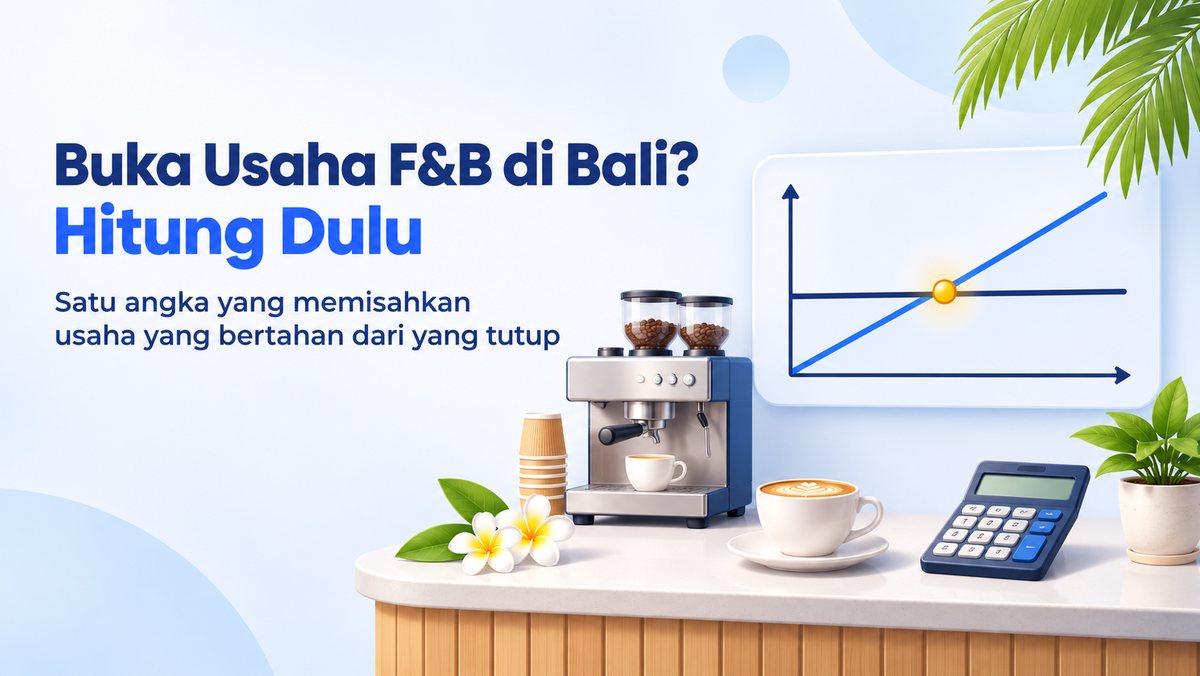
What decides whether a business survives or closes is the one thing most often ignored when drawing up a business plan: whether you know your business's break-even point (BEP). Without this number, you are essentially selling on guesswork, hoping the crowds will cover your costs, without ever knowing how many customers you actually need.
The BEP is the point at which total revenue exactly equals total costs. Below it, you make a loss. Above it, you only then start to make a profit. Knowing this number turns every business decision from a guess into a calculation.
Start with the biggest fixed cost: salaries
To calculate the BEP, we need to know the fixed costs. For an F&B business, one of the largest fixed costs is staff salaries. This is where official data matters, because the minimum wage in Bali is not a figure you can estimate.
Under the Decree of the Governor of Bali on the 2026 UMK and UMSK, the Upah Minimum Kabupaten/Kota (UMK, regional minimum wage) for Denpasar is set at IDR 3,499,878.78 per month. The UMK for Badung is higher, at IDR 3,791,002.57 per month.
Let us translate this into a real cost. A small F&B business with four employees in Denpasar already carries a minimum payroll of around IDR 14 million per month. And that is just the minimum base salary. It does not yet include rent, ingredients, electricity or other operating costs. That IDR 14 million figure is the floor, not the ceiling.
An important note on location
There is one layer that prospective business owners often miss entirely: sectoral wages.
If your business falls within the accommodation and food service sector in Badung, particularly businesses linked to four- and five-star hotels, the Upah Minimum Sektoral Kabupaten (UMSK, sectoral regional minimum wage) of IDR 3,828,912.60 per month applies, higher than the standard UMK. This is a consequence of choosing a particular location and segment.
The lesson is important: choosing a location is not just about how busy it is. The location also determines the cost structure you are bound by. A busy location that requires a higher sectoral wage may be structurally heavier than a slightly quieter location with lower costs. Footfall and costs must be calculated together, not separately.
The part most often skipped: the BEP simulation
Now we come to the core that prospective business owners most often skip, even though it matters most. Let us run a simple simulation for a small coffee shop.
The following figures are illustrative and you can replace them with the conditions of your own business.
Assumptions:
- Average spend per customer: IDR 30,000
- Variable costs: 35 percent of sales (meaning a contribution margin of 65 percent)
- Fixed costs: IDR 40 million per month (salaries, rent and other fixed costs)
The question: how many customers must come in every month for this business not to make a loss?
The formula for BEP in number of customers is:
BEP (customers) = Fixed Costs divided by Contribution Margin per Customer
The contribution margin per customer is the price minus the variable cost per customer. With a price of IDR 30,000 and variable costs of 35 percent, the contribution margin per customer is IDR 30,000 multiplied by 65 percent, which is IDR 19,500.
So:
BEP = IDR 40,000,000 divided by IDR 19,500 = around 2,051 customers per month.
Divided by 30 days, that means around 68 customers per day, just to break even. Only the 69th customer each day starts to generate profit.
You can verify all of these figures yourself with a calculator, and that is their strength. This is not a guess, but the mathematical consequence of the assumptions you put in.
Why this number changes everything
Once you know that your business's BEP is 68 customers per day, every business decision becomes measurable.
A quiet location that can realistically draw only 40 customers per day? You know immediately it is not viable, before you sign a lease and commit capital. A plan to raise the average spend or cut variable costs? Its impact on the BEP can be calculated right away. A revenue target? It can be translated into a concrete number of daily customers.
This is the fundamental difference between decisions based on numbers and decisions based on gut feeling. One gives you clarity before the capital goes out. The other leaves you realising only after the losses have happened. The BEP figure changes the question from "hopefully it will be busy" to "can this location generate at least 68 customers a day?"
One factor that is often forgotten: seasonality
There is one last variable that even experienced business owners often forget: seasonal patterns. Tourism in Bali does not arrive evenly throughout the year.
As an illustration, BPS recorded a sharp fall in foreign tourist visits in November 2025, to around 483,000, from around 595,000 in October. That is a drop of almost 19 percent in a single month. For F&B businesses that rely on tourists, fluctuations like this have a direct impact on cash flow.
The implications are critical. If your cash flow has no buffer to get through the quiet months, even the busy months will not save you. A business that calculates its BEP based only on peak months will be caught off guard when the low season arrives, and that surprise often comes when cash is already running low. A sound calculation builds in seasonality from the start, rather than assuming every month will be as busy as the best one.
How to start calculating before the capital goes out
A few practical steps before you decide to open an F&B business:
Calculate your fixed costs honestly and completely. Include salaries in line with the UMK or UMSK that applies in your location, rent, utilities, and every cost that must be paid whether business is busy or quiet. This figure is the foundation of the entire calculation.
Determine your average spend and contribution margin. How much does one customer spend on average, and what percentage of it remains after variable costs? This determines how quickly you approach the BEP.
Calculate the BEP in daily customers. Translate the monthly BEP into a concrete daily target. A daily figure is far easier to judge as realistic or not than an abstract monthly figure.
Test the viability of the location against the BEP. Ask yourself honestly: can this location realistically generate the number of customers needed? If not, no amount of market buzz will save it.
Prepare a cash flow buffer for the low season. Calculate the BEP assuming quiet months, not busy ones, and make sure you have enough cash reserves to get through periods of low visitor numbers without panicking.
Conclusion
Bali is indeed a welcoming place to start a business. The market is growing, there are plenty of tourists, and the F&B sector is one of its economic drivers. But welcoming does not mean easy. A busy market is an opportunity, not a guarantee, and the gap between the two is filled by one thing: understanding your own numbers.
Before any capital goes out, there is one piece of homework you must not skip: know your numbers. The BEP, the cost structure, and the cash flow buffer. All three can be calculated before you rent a space, before you hire, before a single rupiah goes out. And that is exactly the stage when the calculation is most valuable, while there is still time to change the decision.
Numbers, not gut feeling. That is what separates the F&B businesses that survive from those that close in their first year.
A healthy business is not only one that makes a profit, but one that understands its numbers, controls its risks, and moves with clear direction.
References
All official data in this article can be traced to the following primary sources:
- Foreign tourist visits January-December 2025 (6,948,754 visits, up 9.72 percent). Badan Pusat Statistik (BPS) Bali Province, press release "Kunjungan Wisman Langsung ke Bali Jan-Des 2025 Naik" (Direct foreign tourist visits to Bali Jan-Dec 2025 rise). Available at bali.bps.go.id.
- 2026 UMK for Denpasar (IDR 3,499,878.78), UMK for Badung (IDR 3,791,002.57), and UMSK for accommodation/food service in Badung (IDR 3,828,912.60). Keputusan Gubernur Bali Nomor 1021/03-M/HK/2025 tentang UMK dan UMSK Tahun 2026 (Decree of the Governor of Bali No. 1021/03-M/HK/2025 on the 2026 UMK and UMSK), Dinas Ketenagakerjaan dan ESDM Provinsi Bali (Bali Provincial Office of Manpower and Energy and Mineral Resources). The UMK table is also available at bali.bps.go.id.
- Bali's economic growth and the Accommodation and Food Service sector as a main driver. Berita Resmi Statistik (Official Statistics News), BPS Bali Province (quarterly economic growth release).
- Foreign tourist visits in November 2025 (around 483,000, down from around 595,000 in October 2025). Badan Pusat Statistik (BPS) Bali Province, "Perkembangan Pariwisata Provinsi Bali November 2025" (Bali Province tourism developments, November 2025). Available at bali.bps.go.id.
The BEP simulation in this article is illustrative, with figures that can be adjusted to each business's own conditions. Wage regulations and statistical data may change; please verify against the latest releases before publication.